Bourgeois Dignity: Why Economics Can't Explain the Modern World by Deirdre N. McCloskey
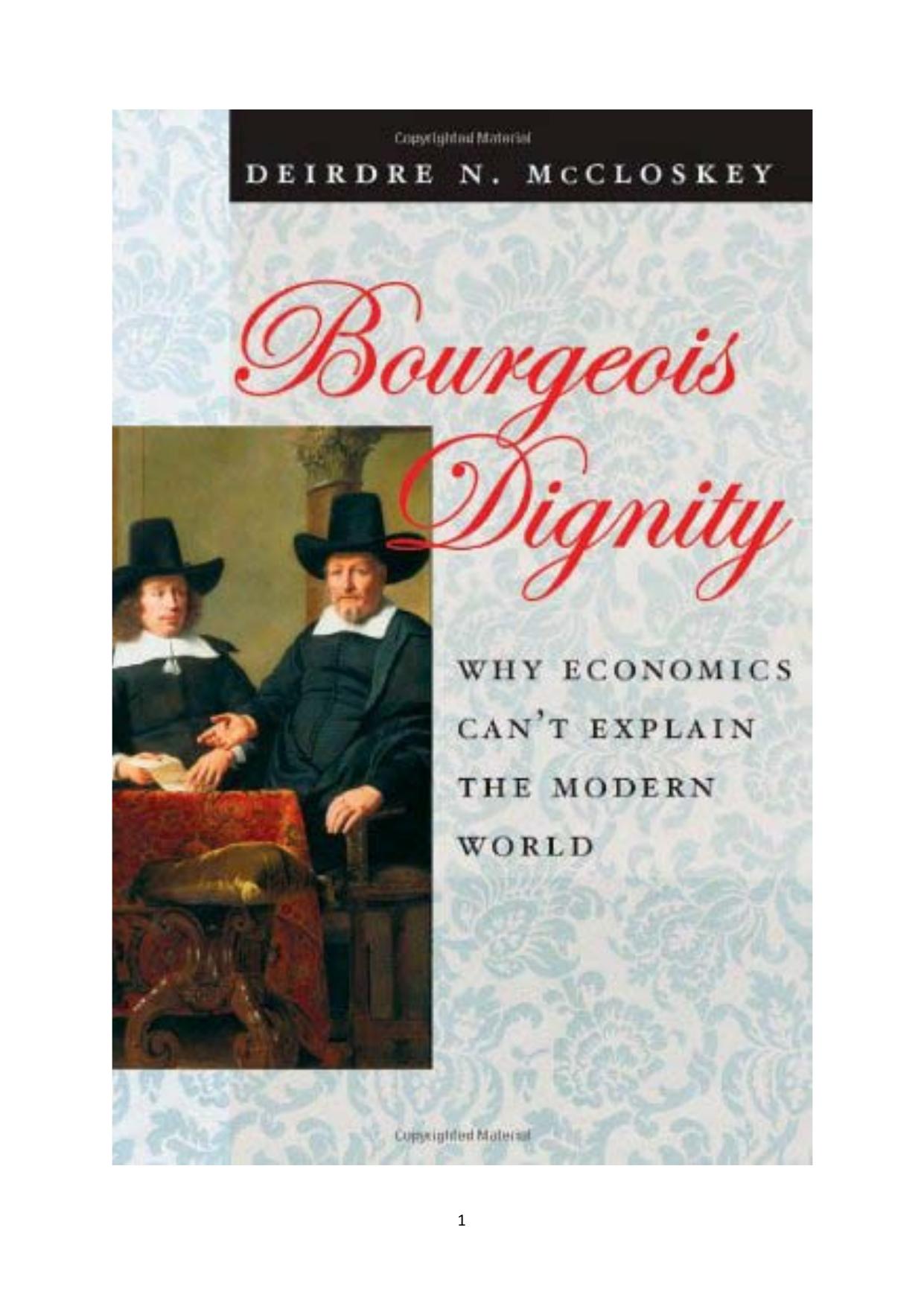
Author:Deirdre N. McCloskey [McCloskey, Deirdre N.]
Language: eng
Format: epub, pdf
Published: 2010-12-11T04:05:00+00:00
Clark is a fine economic and historical scientist and in his book produces much numerical evidence about various assertions with which other economic and historical scientists agree. Yet it is crucial to distinguish the good arguments from the bad, in case some outsider to historical science should think that the good economic /quantitative arguments in the book do anything much to support the bad vulgar-Marxist/eugenic arguments. They don't. The linguist Geoffrey Sampson makes such a point in his devastating rebuttal of the psychologist Steven Pinker's equally eugenic theories of linguistic "nativism": "I should say to start with that I am far from wanting to contradict every point that Pinker [or in our case Clark] makes in his book. Quite a lot ... has little or nothing to do with the nativism issue [or the eugenic theory of bourgeois virtues] and is not at all controversial, at least not among people versed in the findings.... It is possible to read The Language Instinct [or A Farewell to Alms] as a general survey."" Just so in Clark's case-it is a survey, at any rate, of what the numbers, if not the social and literary texts, might be viewed as saying. It is a historical survey, narrow in method but well done by its declared standards of Numbers Only, Please.
Much of Clark's book, in other words, is uncontroversially excellent, a review for outsiders of the quantitative side of what economic historians have learned since, say, Karl Polanyi in 1944. We all, we quantitative economic historians nowadays, agree that down to the seventeenth or eighteenth century England was trapped in a Malthusian logic, as the world has been trapped since the caves. (Some economic historians deny this) but in that case it is hard to see why the modern world did not emerge shortly after the caves.) There was no rapid innovation, though China for example had slowly acquired quite an impressive panoply. Lacking unlimited land or an ongoing explosion of innovations, if you get more mouths to feed then sooner rather than later you will get less bread per mouth. In consequence the life of man remained nasty, poor, brutish, and short.'8 All the economic historians whom Clark is summarizing agree that the escape from the Malthusian trap is the most important economic event in world history. And we agree on the magnitude of the escape: in the teeth of gigantic increases in population "the richest modern economies are now [conservatively measured, not taking account of better quality] ten to twenty times wealthier than the 1800 aver- age."19 We agree that the cause of the Great Fact was innovation, not capital accumulation-though we have to keep reminding our colleagues in economics of this. We agree that the Fact happened first in Holland and then in England and Scotland. We agree that in China and especially in Japan there were some signs around 1600 that it might happen there, and some of us think that it was short-circuited by Qing and Tokugawa tyranny and inegalitarianism and scorning of merchants.
Download
Bourgeois Dignity: Why Economics Can't Explain the Modern World by Deirdre N. McCloskey.pdf
This site does not store any files on its server. We only index and link to content provided by other sites. Please contact the content providers to delete copyright contents if any and email us, we'll remove relevant links or contents immediately.
International Integration of the Brazilian Economy by Elias C. Grivoyannis(111059)
The Radium Girls by Kate Moore(12028)
Turbulence by E. J. Noyes(8049)
Nudge - Improving Decisions about Health, Wealth, and Happiness by Thaler Sunstein(7706)
The Black Swan by Nassim Nicholas Taleb(7129)
Rich Dad Poor Dad by Robert T. Kiyosaki(6632)
Pioneering Portfolio Management by David F. Swensen(6300)
Man-made Catastrophes and Risk Information Concealment by Dmitry Chernov & Didier Sornette(6019)
Zero to One by Peter Thiel(5802)
Secrecy World by Jake Bernstein(4753)
Millionaire: The Philanderer, Gambler, and Duelist Who Invented Modern Finance by Janet Gleeson(4478)
The Age of Surveillance Capitalism by Shoshana Zuboff(4292)
Skin in the Game by Nassim Nicholas Taleb(4248)
The Money Culture by Michael Lewis(4207)
Bullshit Jobs by David Graeber(4190)
Skin in the Game: Hidden Asymmetries in Daily Life by Nassim Nicholas Taleb(4006)
The Dhandho Investor by Mohnish Pabrai(3764)
The Wisdom of Finance by Mihir Desai(3746)
Blockchain Basics by Daniel Drescher(3582)
